How earthwork volumes are calculated, with worked examples of the grid method and average end area method, plus swell, shrink, balancing, and how to turn the numbers into a priced bid.
By the KonBid team · Published
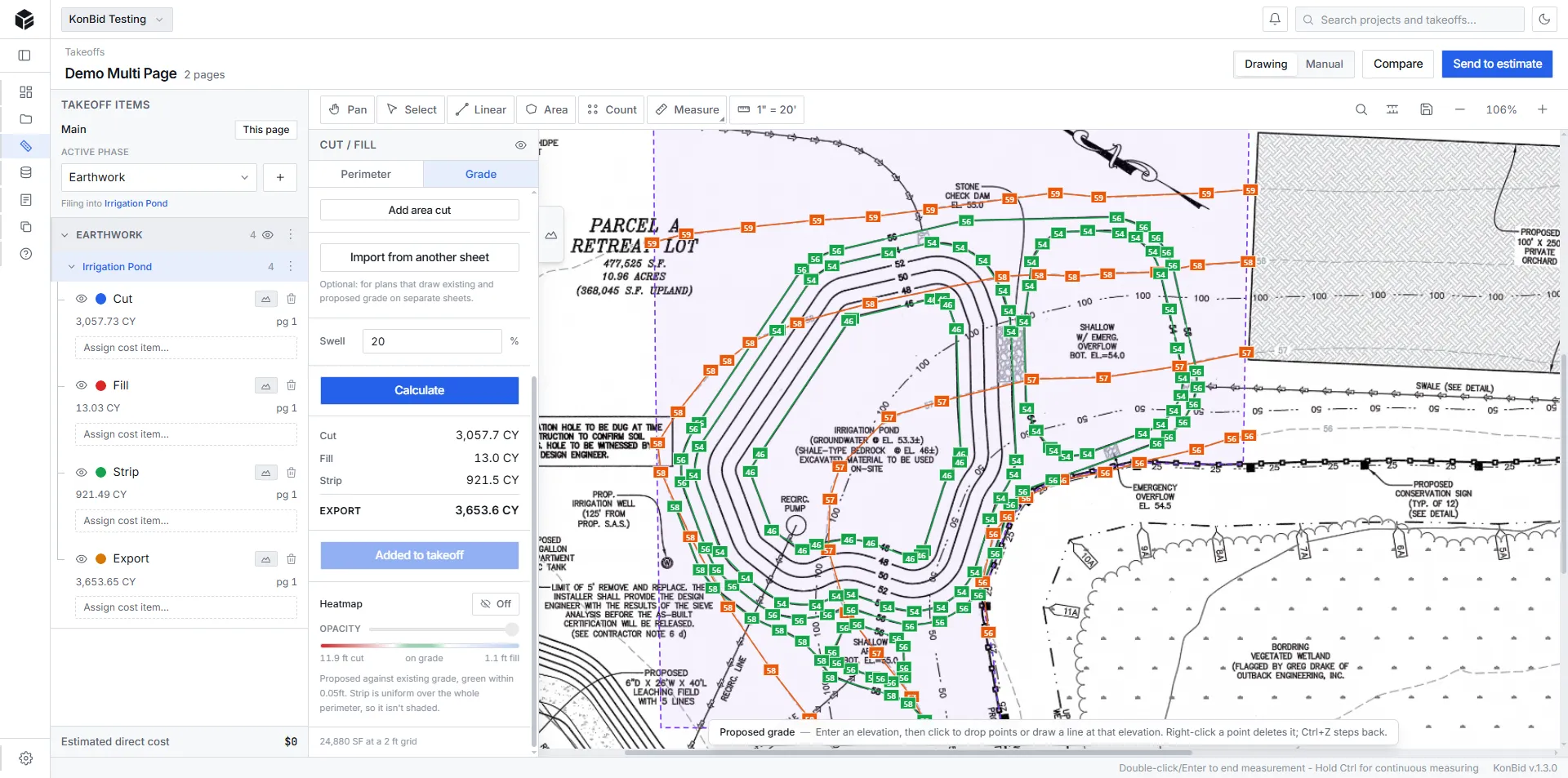
Cut is earth removed where the existing ground is higher than the proposed finished grade. Fill is earth placed where the existing ground is lower than the proposed grade. A cut and fill calculation compares existing and proposed elevations across a site to find how many cubic yards must be excavated, placed, imported, or exported.
Earthwork is often the largest and riskiest line in a sitework or excavation bid. A one-foot error across an acre is more than 1,600 cubic yards of material, enough to turn a profitable job into a loss. Understanding how the volumes are calculated helps you check software output, explain numbers to an owner, and spot plans that do not balance.
The key inputs are always the same: existing grades, usually from a topographic survey, and proposed grades from the grading plan.
The grid method divides the site into equal squares, finds the cut or fill depth at each grid corner by subtracting proposed elevation from existing elevation, averages the corner depths for each square, and multiplies by the square area. Summing every square and dividing cubic feet by 27 gives total cubic yards.
One 50 × 50 ft square (2,500 SF) has corner cut depths of 1.2, 1.8, 2.0, and 1.4 ft.
Squares that contain both cut and fill corners need to be split or handled with smaller grid spacing. Smaller grids give more accurate results on uneven terrain but take longer by hand, which is why most estimators now let takeoff software do the math.
The average end area method is used for linear work such as roads, trenches, channels, and embankments. You measure the cross-section area of cut or fill at regular stations, average each pair of neighboring sections, and multiply by the distance between them. It is simple and accurate when cross-sections change gradually.
Where A1 and A2 are end areas in square feet and L is the distance between stations in feet.
A road cut has a cross-section area of 42 SF at station 1+00 and 58 SF at station 1+50.
Repeat for every pair of stations and add them up. Where a section transitions from cut to fill, treat the cut and fill portions separately.
Soil volume changes as it moves. Bank cubic yards are measured in the ground, loose cubic yards in the truck after excavation swells the material, and compacted cubic yards in place after compaction. Apply a swell factor to price trucking and a shrink factor to know how much cut is needed to make a given amount of fill.
| Material | Typical swell | Typical shrink when compacted |
|---|---|---|
| Sand and gravel | 10–15% | 5–10% |
| Common earth | 20–30% | 10–20% |
| Clay | 30–40% | 10–25% |
| Blasted rock | 50–65% | Often expands; does not shrink |
These are general industry ranges for planning only. Use the geotechnical report or your own job history when you have it.
Example: 1,000 bank CY of common earth at 25% swell is 1,250 loose CY to haul. To build 1,000 compacted CY of fill with 15% shrink, you need about 1,177 bank CY of suitable material.
A balanced site uses its own cut to build its fill, with nothing hauled in or out. After adjusting for shrink, compare usable cut to required fill. Extra cut becomes export, priced with trucking and disposal. A shortfall becomes import, priced with material, trucking, and placement. Unsuitable soils and topsoil stripping change the balance.
Do not forget the volumes that are not in the grading plan: topsoil stripping that will be stockpiled and respread, unsuitable material that cannot be reused, and structure excavation for foundations, utilities, and ponds. Each can tip a site from balanced to a major export.
Once you have volumes, price them by production. Divide each quantity by your crew's production rate to get hours, multiply hours by equipment and labor rates, and add trucking, disposal, import material, and compaction. In KonBid, cut and fill volumes push straight from the takeoff into the estimate, where assemblies apply those rates.
For a full walkthrough of production rates, trucking cycle times, and markup, read how to price excavation work. To see the calculation done on a real plan, look at the cut and fill engine in the digital takeoff software, or how it fits into excavation estimating software and sitework estimating software.
FAQ
Quick answers on cut and fill calculation explained. KonBid handles this workflow from takeoff to proposal for a flat $79 per month for your whole company, with a 14-day free trial that includes every feature and requires no credit card to start.
Find the depth of cut or fill at many points by subtracting proposed elevation from existing elevation, multiply average depth by area to get cubic feet, then divide by 27 to get cubic yards. The grid and average end area methods organize this math.
Accuracy depends on point density. A tight grid or closely spaced cross-sections, or a surface-to-surface comparison in software, is more accurate than a coarse grid on uneven ground.
Excavation is usually measured in bank cubic yards, while trucking should be priced in loose cubic yards after applying swell. Fill is usually specified in compacted cubic yards.
Yes. KonBid compares existing and proposed grades on your site plan to calculate cut, fill, and net volumes, then sends those quantities straight into the estimate for pricing.
14-day trial · No credit card
KonBid is a flat $79 per month for your whole company, with no per-seat fees and no sales call. Start a 14-day free trial with full access to digital takeoffs, the custom cost database, assemblies, and proposal exports, then build your first real bid in minutes.