A step-by-step method for pricing excavation: start from bank quantities, apply production rates, cost equipment, labor, and trucking, then add disposal, overhead, and profit. Includes a worked example.
By the KonBid team · Published
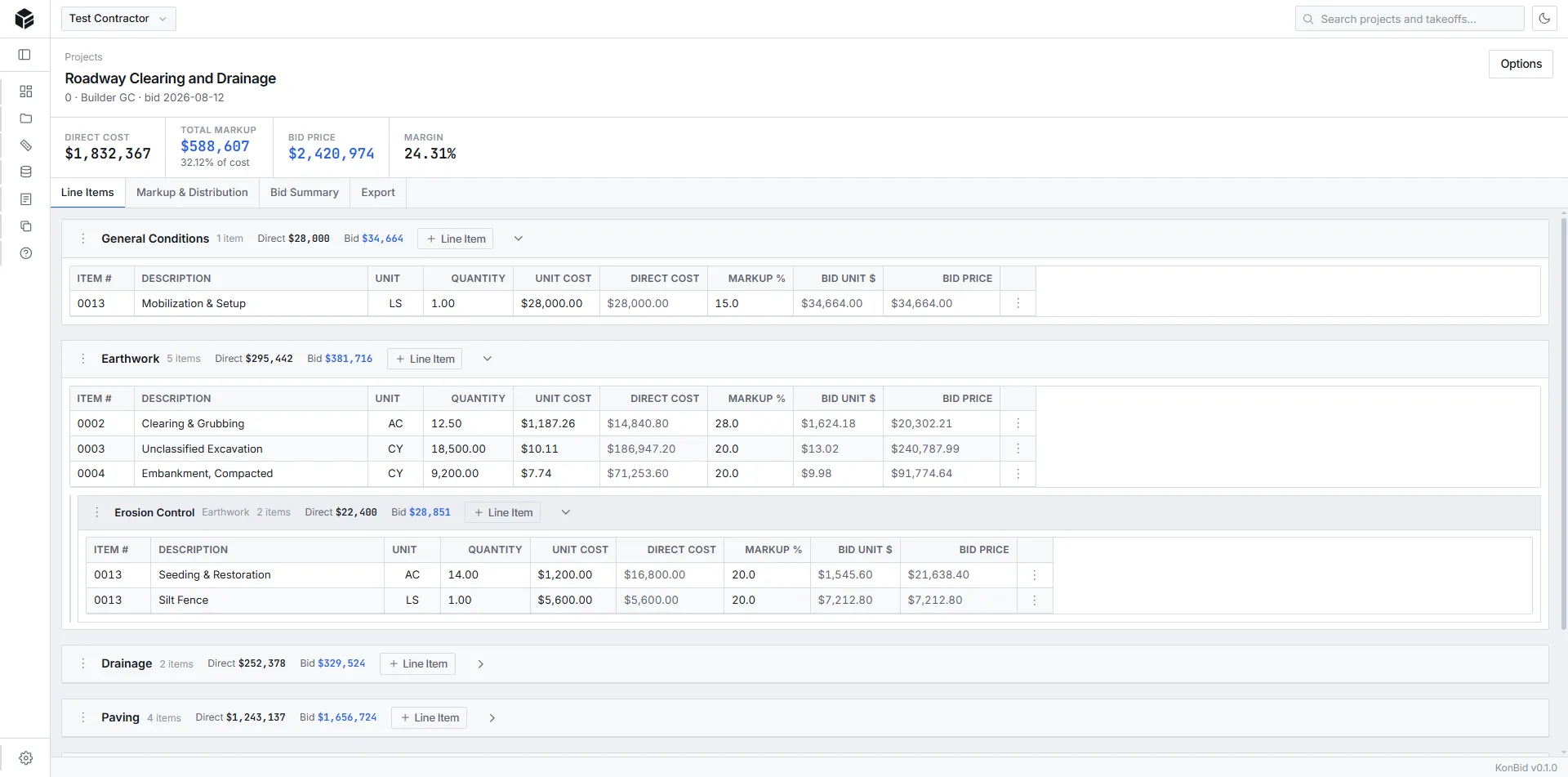
Excavation is priced by production, not by guesswork. You measure how many cubic yards must move, estimate how many cubic yards per hour your crew and equipment can move, convert that to hours, and multiply hours by your equipment, labor, and trucking rates. Disposal, import material, mobilization, overhead, and profit are then added.
Unit prices like "$12 per yard" are useful for sanity checks, but they hide the variables that make or lose money: haul distance, soil type, access, water, and rock. Building the price from production keeps those variables visible, so you know exactly why one dig costs twice what another does.
Start with bank cubic yards from a takeoff of the plans or a cut and fill calculation. Separate the quantity by material and method, such as topsoil stripping, common excavation, rock, trench, and structure excavation, because each one has a different production rate, haul requirement, and cost.
If your quantities come from grades, follow the methods in cut and fill calculation explained. For foundations and simple digs, measure the area and depth, and remember to include overdig for working room and slopes. A takeoff connected to the estimate, like the digital takeoff software in KonBid, keeps these quantities current when plans change.
Convert bank cubic yards to loose cubic yards for any material that will be hauled, using a swell factor for the soil type. For material that will be placed as compacted fill, apply a shrink factor to find how much bank material is needed. Trucking is always priced on loose volume.
Common earth often swells 20 to 30 percent. Use your geotechnical report or job history when you have it, because swell drives the number of truck loads more than any other factor.
Production rate is how many bank cubic yards per hour your excavator or loader actually moves on this job, after accounting for bucket size, cycle time, soil, operator skill, and efficiency. Divide the quantity by the production rate to get equipment hours, and round to realistic shifts or days.
Rated equipment output is a ceiling, not a plan. Real production is lower due to truck exchange time, repositioning, grade checking, and weather. Most estimators apply an efficiency factor, often in the range of 45 to 50 working minutes per hour, or simply use their own historical production by machine and material.
In KonBid, crews and production rates are stored with your assemblies, so duration is calculated from the quantity automatically instead of being worked out on a calculator.
Multiply equipment hours by your hourly equipment rate, which should cover ownership, fuel, maintenance, and wear, and labor hours by burdened wage rates. For trucking, calculate the cycle time from load, haul, dump, and return, then work out how many trucks are needed to keep the excavator busy and multiply by hours.
If a truck takes 50 minutes to load, haul, dump, and return, and the excavator fills a truck in 7 minutes, you need about 7 trucks to keep the excavator from waiting. Too few trucks and the excavator idles; too many and trucks wait in line. Both cost money.
Add the costs that are not equipment time: disposal or tipping fees for export, purchased import material, compaction and testing, dewatering, erosion control, traffic control, and mobilization. These are easy to forget and often decide whether a job makes money, so build them into your excavation assemblies.
Here is an illustrative bid for excavating 1,200 bank cubic yards of common earth and hauling it off site. The rates are examples only. Replace them with your own equipment, labor, trucking, and disposal costs, which is exactly what a custom cost database in estimating software is for.
| Item | Calculation | Cost |
|---|---|---|
| Excavator with operator | 12 hr × $175 | $2,100 |
| Trucks | 7 trucks × 12 hr × $105 | $8,820 |
| Laborer / grade checker | 12 hr × $55 | $660 |
| Disposal | 108 loads × $150 | $16,200 |
| Mobilization | Lump sum | $1,200 |
| Direct cost | $28,980 | |
| Overhead | 10% | $2,898 |
| Profit | 10% on cost plus overhead | $3,188 |
| Bid price | $35,066 |
That works out to about $29.22 per bank cubic yard. Notice that disposal is more than half the direct cost. Change the dump site and the price moves more than any equipment decision, which is why it pays to price from production instead of a single unit price.
Excavation estimating software stores your equipment, labor, trucking, and disposal rates once, applies them through assemblies and crews with production rates, and recalculates the bid when quantities change. KonBid does this from takeoff to proposal for a flat $79 per month, with a 14-day free trial.
See how it works for excavation contractors, septic installers, and land clearing, or explore the construction estimating software features.
FAQ
Quick answers on price excavation work. KonBid handles this workflow from takeoff to proposal for a flat $79 per month for your whole company, with a 14-day free trial that includes every feature and requires no credit card to start.
There is no single right number because haul distance, soil, disposal, and access drive the cost. Build the price from production, equipment, trucking, and disposal, then compare the resulting cost per yard to your past jobs as a sanity check.
Multiply bucket capacity by cycles per hour, adjust for bucket fill factor and soil, then apply a job efficiency factor. Your own historical production by machine and material is usually more reliable than rated output.
Divide the full truck cycle time, including load, haul, dump, and return, by the time it takes the excavator to load one truck. Round to the number of trucks that keeps the excavator working without trucks waiting in line.
Markup depends on your overhead, market, and risk. Many contractors add separate overhead and profit percentages. Whatever you use, apply it consistently by category so you can see your margin before you send the bid.
14-day trial · No credit card
KonBid is a flat $79 per month for your whole company, with no per-seat fees and no sales call. Start a 14-day free trial with full access to digital takeoffs, the custom cost database, assemblies, and proposal exports, then build your first real bid in minutes.